Monday, January 19, 2009

Bethlehem - Shepherd's Field


We visited the chapels in the caves where the shepherds would have kept their sheep safe and warm at night. Also, there is a chapel above the caves with glass circles in the ceiling to imitate the stars at night.

At the time of Jesus, shepherds were people of low esteem. They were poor nomads, often looked upon with suspicion, holding no social or religious sta¬tus in Israel. That they would be chosen as the first to hear the "good news of great joy" (verse 10) is surely an indication that God has "lifted up the lowly" (1:52). Jesus' birth among the poor anticipates his ministry to the poor and outcasts of Israel's society. He, whose birth was first announced to shepherd in the fields, will become the good shepherd of the sheep.

Sunday, January 18, 2009

Holy Sepulchre & Holy Mass


We finally made it to the most Holy Place in Christian tradition, the location of the event on which our faith either stands or falls, Jesus' empty tomb. We had to wait a few minutes as the Franciscan Friars prayed this station of the cross and then were allowed to go into this chapel a few at a time. It was truly amazing to be here! After our visits we celebrated Mass in the "Crusaders Chapel" less than a stones throw away. And of course we celebrated Easter Mass with lots of Alleluias! What a celebration!
Protestants generally do not recognize this site as authentic. They have a place nearby which looks like what the tomb would have looked like, with the roll-away stone, etc. A little history will help explain why this no longer looks like the tomb of Jesus as we might imagine it.
With the Edict of Milan in 313 AD (end of Christian persecution in the Roman Empire), the Christians returned to Jerusalem and to the other holy sites. Emperor Constantine, son of St. Helena, built a complex including a Basilica to include Calvary and a rotunda over the Sepulcher. To do this, he leveled off the sides of Calvary so that it became a balcony. He also cleared the hill away from around the cave of the tomb.
614 AD Assyrians invaded Holy Land and destroyed the Holy Sepulcher.
628 AD, the Muslims conquered Jerusalem
1099 AD The Basilica, as it now stands, was completed by the Crusaders, incorporating elements of the previous Edifices.
1950s restoration began

Mount Golgotha (Calvary)


We arrived at the end of the Stations at Calvary. The Armenians were celebrating Christmas so we had to wait a little while until we could enter the Church which houses Calvary and the Holy Sepulcher. We first took a group picture and then entered. We walked up the steps and prayed the final station. Then as we were taking our turns to touch the stone where Jesus was crucified, we were asked to leave quickly because the Franciscans were about to come up as they were making the stations. So we did as told. However, when we got to the bottom we prayed the last station, the Resurrection. As we began to sing a friar approached us and told us not to sing. He shook his finger at Fr. Brian and told him that they had been celebrating the stations since the 14th century and we should respect them and be quiet. Then after the good scolding, he asked if there was a priest in our group named Fr. Brian, because he was looking for him. Fr. Brian said, "I am him." And all had a good chuckle!

Via Dolorosa


We walked the stations of the cross which are marked with metal Roman numerals on the walls as you walk along. We carried a cross as we walked and a different group carried the cross after each station. During our walk shop owners were beckoning us to their shops and a few even shared their disdain about the USA or our faith. However, it was amazing to see some passer-bys stop to kiss the cross as we walked along. They witnessed to our faith in a beautiful, quiet way.

Dead Sea Scroll Museum (Map of Jerusalem)


This museum does house an exhibit about the Dead Sea Scrolls. However, this miniature of Jerusalem at the time of Jesus must be the main attraction. We walked all around it as our tour guide explained all of the parts of the city. You'll just have to go there if you want a detailed explanation!

Western Wall (Wailing Wall)


Orthodox Jews come here to pray daily. Many recite prayers and psalms lamenting the destruction of the temple. Many people place prayer intentions written on small pieces of paper in the crevices. Pope John Paul II visited here and prayed which endeared many of the Jews to him and the Catholic Church.

At the Western Wall Plaza, the total height of the Wall from its foundation is estimated at 105 feet (32 m), with the exposed section standing approximately 62 feet high. The Wall consists of 45 stone courses, 28 of them above ground and 17 underground. The first seven visible layers are from the Herodian period. The original temple built by Solomon had 12 courses of stones for the twelve tribes of Israel.

Dominus Flevit


As we walked down the hill towards the Garden of Gethsemane, we passed an ancient Jewish cemetery that is still in use. Then we entered this chapel. It was built to recall the lament of Jesus over Jerusalem, the city of peace. Jesus loved this city and its temple as his own, but he knew that it was bringing destruction upon itself because of its refusal to listen and obey its God.

The chapel which was built in 1955 is shaped in the form of a tear, and from its interior window can be seen a wondrous view of the walled city and its temple mount. The first shrine with beautiful Christian symbols was shrine was built in the 5th century but it was destroyed in 614 A.D. Each of the gospels express Jesus' lament over the city differently.

In Matthew's gospel Jesus expresses the deep desire to enfold the city in his arms, "as a hen gathers her brood under her wings" (Matt 23:37). But "the city that kills the prophets and stones those who are sent to it" would not let him. In Mark's gospel, Jesus pauses to curse a fig tree, an Old Testament symbol of Israel, for its lack of fruit (Mark 11:13-14). Like the unproductive tree, Jerusalem would meet its fate because of its failure to bear fruit.

Chapel of the Ascension


Our first stop of the day was the Dome of the Ascension. This marks the traditional site where Jesus ascended into heaven. The biblical text is not clear as to where the Ascension took place (cf. Mt 28:16; Lk 24:50). The ascension of Jesus is commemorated at a circular shrine on the top of the Mount of Olives. There a rough piece of rock marks the place where an early tradition says that Jesus left this world to return to the Father. An earlier shrine of the fourth century consisted of a circular colon¬nade around the rock that was open to the sky. The distance between this shrine and the city of Jerusalem is "a Sabbath day's journey" (Acts 1:12), about half a mile, the maximum allowable distance a Jew could travel on the Sabbath. The Crusaders rebuilt the shrine. This shrine passed into the hands of Muslims in 1198.

Saturday, January 17, 2009

Garden of Gethsemane


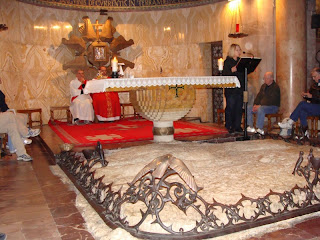
After our welcome to the city, we made our first pilgrim stop in Jerusalem, the Garden of Gethsemane. There are olive trees there estimated to be about 1000 years old but whose roots are likely those of the trees there at the time of Jesus. So, yes, this is what the garden would have looked like. The place where Jesus left Peter, James and John (a stones throw away) was just across the street. Inside the Church of All Nations we celebrated Mass on the altar just behind the stone on which Jesus sweated blood and where the angels ministered to him. This is where he faced a temptation like that of Adam and Eve and stood faithful - he crushed the head of Satan. Here on this spot... Amazing!

Overview:
There are two shrines to consider the Agony of Christ at the Garden of Gethsemane. The first is the cave called the Grotto of Betrayal next to the Tomb of the Blessed Mother. This is the cave where the eight apostles remained while Jesus, Peter, James and John went a “stone’s throw away” (Luke 21:42) to pray as well as the scene of Jesus’ arrest
The second is Garden of Gethsemane, an enclosed grove of olive trees and the Basilica of the Agony or Church of All Nations. A Byzantine church was built in the 4th century with beautiful mosaics but destroyed by the Persians in 614. The Crusaders built another church in 1170. The present church was rebuilt over the Byzantine church in 1925.

THE AGONY (Luke 22:39-53)
Then going out he went, as was his custom, to the Mount of Olives, and the disciples followed him. When he arrived at the place he said to them, "Pray that you may not undergo the test." After withdrawing about a stone's throw from them and kneeling, he prayed, saying, "Father, if you are willing, take this cup away from me; still, not my will but yours be done." (And to strengthen him an angel from heaven appeared to him. He was in such agony and he prayed so fervently that his sweat became like drops of blood falling on the ground.)

After Mass we headed for our Hotel, The Jerusalem Gate, our home for the rest of the trip. It is a Jewish section of the modern city so we encountered the celebration of the end of the Sabbath when we arrived on Saturday evening.

Welcome to Jerusalem


View of the Old City and ceremonial welcome.